

Yields Are Soaring... Is China Pulling the Trigger?

Updated: Apr 10, 2025

Introduction: A New Front in the U.S.-China Trade War
The ongoing U.S.-China trade conflict has always involved more than just tariffs. As tensions escalate, a new and more dangerous weapon has emerged from China’s arsenal: the strategic dumping of U.S. Treasury bonds. With over $770 billion in American debt under its control, China holds enough leverage to ignite a financial chain reaction that could expose the U.S. Federal Reserve’s structural weaknesses and destabilize the global economy.
The Fragile Foundation: Why U.S. Treasuries Matter So Much
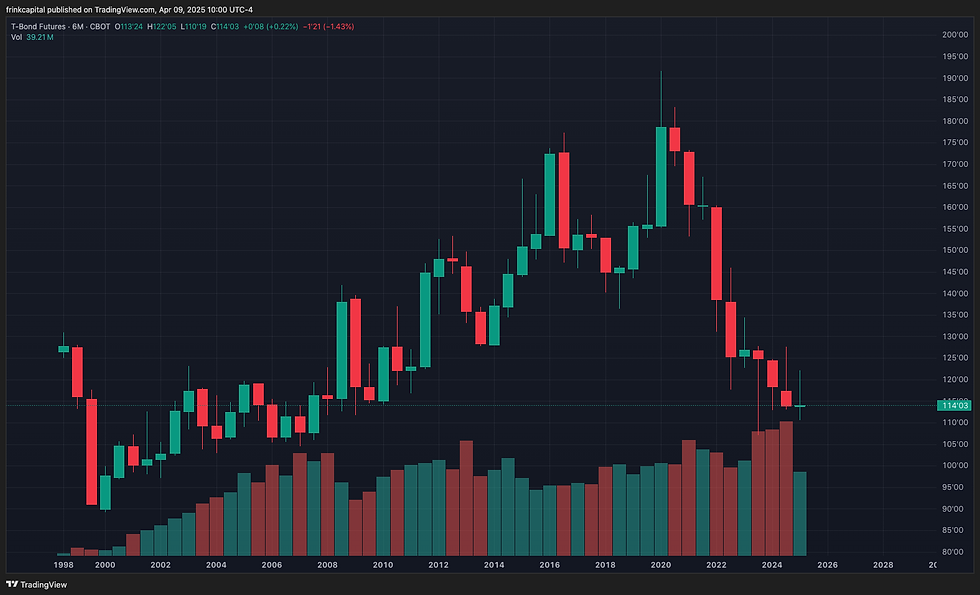
"When U.S Bonds depreciate they in turn raise the yields on those bonds which ultimately raises interest rates"
U.S. Treasury bonds are the lifeblood of global finance. They back the U.S. dollar, set the benchmark for global interest rates, and anchor the balance sheets of major institutions worldwide. Foreign governments, banks, and pension funds rely on them as a safe haven.
However, this reliance also makes the U.S. economy vulnerable. A sudden flood of Treasuries onto the market—especially from a power player like China—can send bond prices tumbling and interest rates skyrocketing.
Higher yields might look good for savers, but they come with severe consequences:
Mortgages and consumer loans become unaffordable
Corporate debt burdens explode
Federal interest payments balloon, draining budgets
In short, the very foundation that has enabled America to run large deficits and fund global dominance is now at risk.
China’s Silent Strike: Dumping Debt as Economic Warfare
"China doesn’t need missiles or tanks to strike at the heart of the American economy. It only needs to clicks sell."
Controlled, strategic offloading of Treasuries would:
Push yields up across the board, making U.S. debt more expensive
Frighten other bondholders, who may follow suit to avoid losses
Force the Fed to intervene in already overstretched markets
This is not speculation. We saw China sell over $250 billion in Treasuries during its 2015 currency crisis. Russia, too, dumped 95% of its holdings ahead of the Ukraine conflict to dodge sanctions.
If relations sour further or Washington imposes broader financial sanctions, Beijing may accelerate its exit from U.S. debt—and this time, the implications could be far worse.

How the Fed Gets Cornered: Outdated Tools in a New Era
The Federal Reserve, built for a 20th-century economic model, is increasingly unequipped to deal with 21st-century financial warfare.
Here’s what could happen if China makes a big move:
Interest Rate Shock: As yields surge, mortgage rates could surpass 8%, destroying housing demand.
Corporate Chaos: Businesses refinancing at higher rates may face insolvency.
Stock Market Slide: Investors flee equities for safer yields, triggering sell-offs.
To contain the damage, the Fed has three outdated choices:
QE4 (Quantitative Easing): Pump money into the system to buy Treasuries, risking inflation.
Yield Curve Control: Cap rates artificially, distorting real market signals.
Coordinate with Allies: Ask Japan and Europe to help buy U.S. debt—a short-term fix that only masks the structural rot.
None of these tools fix the root problem. They delay the inevitable.
What a Full-Blown Financial War Looks Like
If China goes all in, the dominoes fall fast:
The Dollar Surges: Crushing emerging market economies that rely on dollar debt.
Commodities Tank: Global demand weakens as financing dries up.
Investor Panic: Safe havens disappear. Volatility becomes the norm.
And worst of all, the U.S. faces a confidence crisis. If the world stops trusting Treasuries as the ultimate safe asset, the dollar’s dominance erodes—and with it, America’s economic hegemony.
Toward a Structural Reset: America at the Crossroads
This crisis is more than a geopolitical spat. It’s a symptom of a deeper truth: the U.S. financial system, and especially the Fed, is running on outdated assumptions.
The Fed was never designed for digital capital flight or currency wars.
It relies too heavily on domestic tools in an increasingly global battlefield.
Its forecasts and models don’t account for nations using debt as a weapon.
If America wants to survive the next decade, it needs more than patchwork solutions:
A new financial architecture that limits foreign leverage on domestic debt
A reshoring of monetary control back to productive domestic assets
A paradigm shift in how value, capital, and trust are measured in the digital age
Conclusion: The Clock Is Ticking
We are witnessing the unraveling of the post-Bretton Woods consensus. In this high-stakes game of financial chess, China is playing the long game, using subtle, systemic moves to reshape the board.
Meanwhile, America clings to tools and strategies crafted for a different time. Unless it evolves—quickly—the coming Treasury crisis may not just be another market event. It could be the moment the world realizes the emperor has no clothes.
Change is no longer optional. It’s inevitable.
Let's see how the 🎲 roll.
Comments